Showing posts with label Cnn. Show all posts

Saturday, January 21, 2012

Is Mexico City safe from drug cartel war -- or the next target?

Editor's note: This story is the third in an occasional series looking at the violence tied to Mexican drug cartels, their expanding global connections and how they affect people's daily lives. A previous article focused on the more than 5,300 people who've disappeared.

Mexico City (CNN) -- Near the ruins of an ancient Aztec temple, a woman shouting into a microphone claims Mexican society is crumbling.

"We are no longer free to walk in the streets because of what is happening," she yells.

Demonstrators behind her tape cardboard crosses to a fence in front of Mexico's National Palace. The names of slaying victims are scrawled with black magic marker on each one.

"I want the impunity to end," a leftist lawmaker says, blaming Mexican President Felipe Calderon's five-year-long crackdown on drug cartels for the surge in violence.

A handful of people clap. But throngs walk through Mexico City's massive central square without glancing in his direction.

In this sprawling metropolis, the brutal conflicts between drug cartels and government troops are both strangely absent and omnipresent. They are nowhere to be found and everywhere you look.

At a corner newsstand, the front page of a paper shows a dead man lying in a pool of blood. The cover of a magazine pictures people praying at a funeral.

At an airport gift shop, a book about beauty queens in the drug trade is only steps away from bottles of tequila and souvenir sombreros.


From the halls of his official residence here, President Calderon announced plans in late 2006 to deploy troops in a nationwide crackdown on drug cartels.

Here, too, a peace movement led by a poet whose son was slain has taken root, with protesters staging "caravan" demonstrations that go from the city's central square to some of the country's most violent areas.

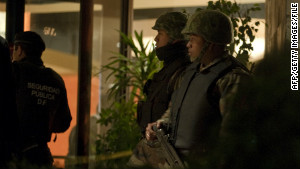
But the gun battles, mass graves and fiery road blockades in other parts of the country aren't part of daily life in Mexico's capital.

Organ grinders, food vendors and street performers play to a constant stream of people who flood the sidewalks.

The city, once dogged by a reputation for being crime-ridden, has become a refuge.

"Just a decade ago people in Mexico City would say they wanted to leave and live in the surrounding states to have a more peaceful life. Today, paradoxically, Mexico City has become one of the safest places to live," Mexico City lawmaker Lizbeth Eugenia Rosas Montero said at a recent government meeting. "Now the people who live in the states spend their vacations in the capital to be away from the shootouts, kidnappings and executions."

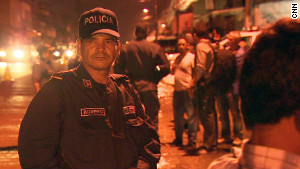
But crime still creeps in to the heavily policed capital.

The densely populated city and surrounding state of Mexico are profitable turf for drug dealers. Local gangs fighting over sales fuel most drug-related violence there, says Ana Maria Salazar, a former Pentagon counternarcotics official who lives in Mexico City and hosts a weekly television program on the country's security issues..

Murder rates in Mexico's capital are half the national rate of 18 per 100,000 residents, and are lower than homicide rates in U.S. cities like New Orleans and Washington. But that hasn't stifled fears that something bigger could be brewing.

The city saw more than 120 killings related to organized crime between January and September last year, according to Mexico's Attorney General's Office. In the neighboring state of Mexico, the number was much higher, nearly 600.

"Mexico City, for whatever reason, has not been a battleground," Salazar says. "It could very easily become that."

Finding comfort in the chaos


Julia Alonso crammed as much as she could into a suitcase and headed for Mexico City last year.
Source-cnn

Ambush on Syrian police truck kills 14


(AP)

BEIRUT — At least 14 people were killed when multiple explosive devices struck a police truck transporting prisoners in a tense area of northwestern Syria on Saturday, the state-run news agency and an opposition group said.

The state news agency SANA blamed the attack on "terrorists" and said it occurred on the Idlib-Ariha highway, an area near the Turkish border that has witnessed intense fighting with army defectors recently.

Four bombs that went off in "two phases" hit the truck, and then attackers targeted an ambulance that arrived to assist the wounded, SANA reported.

Six policemen who were accompanying the prisoners were also wounded, some of them in critical condition, it said.

The British-based opposition activist group, the Syrian Observatory for Human Rights, confirmed the incident Saturday and put the toll at 11 dead prisoners.

Syrians protest by thousands as violence goes on
Syria's opposition: "We will carry on"

Rami Abdul-Rahman, director of the group, said the truck was hit by several roadside bombs, but it was not clear who was behind the attack.

There was no immediate claim of responsibility, but members of the so-called Free Syrian Army are known to be active in the area.

A Syria-based activist said the area has several army encampments and is full of roadside bombs planted to target army tanks passing by, adding that the truck carrying prisoners may not have been the intended target.

The activist spoke on condition of anonymity for fear of reprisals.

The 10-month uprising against Syrian President Bashar Assad has turned increasingly militarized and chaotic as more frustrated regime opponents and army defectors arm themselves and fight back against government forces.

The capital has seen three suicide bombings since late December which the government blamed on terrorist extremists.
Source-cbsnews

Friday, January 20, 2012

U.S. chopper crashes in Afghanistan; 6 dead


KANDAHAR, Afghanistan - A NATO helicopter has crashed in southern Afghanistan, killing six members of the international military force, the U.S.-led coalition said Friday.

Sources in Afghanistan and Washington tell CBS News it was a U.S. Marine CH-53 helicopter that crashed, and a U.S. military official tells the Associated Press that all those killed were Marines, but the coalition has not officially disclosed the nationalities of the victims. Details of such incidents are generally kept private until the families of the dead are notified.

CBS News is still seeking independent confirmation on the nationalities of the crash victims.

France halts Afghan training after 4 troops shot
The rise of (un)friendly fire in Afghanistan
Special section: Afghanistan, 10 Years Later

The cause is still being investigated, but a coalition statement said there was no enemy activity in the area at the time of Thursday's crash, which brought the number of international forces killed in Afghanistan this month to 24.

CBS News correspondent Mandy Clark reports that some military sources are pointing to a likely mechanical failure, but they say it's too early to determine exactly what brought the helicopter down in the Taliban-dominated area.

The Taliban claimed responsibility for bringing the helicopter down in a statement to CBS News, but Clark says the militant group often exaggerates claims of military success. NATO has denied any Taliban involvement.

It was the deadliest crash in Afghanistan since August, when 30 American troops died after a Chinook helicopter was apparently shot down in Wardak province in the center of the country.

The helicopter crash occurred on the same day that a rogue Afghan soldier opened fire on French troops in the country on a training mission, killing four and leading French President Nicolas Sarkozy to immediately halt all training operations in Afghanistan. He also said he may consider pulling all French troops out of the country sooner than planned.

Meanwhile, a suicide car bomber killed at least seven civilians Thursday outside a crowded gate at Kandahar Air Field, a sprawling base for U.S. and NATO operations in the south. The Taliban insurgents claimed responsibility, saying they were targeting a NATO convoy.

It was the second suicide bombing in as many days in southern Afghanistan, officials said. The coalition said no NATO troops were killed Thursday. It does not disclose information about wounded troops.

The Taliban have been stepping up attacks in southern Afghanistan, the birthplace of the insurgency, with a wave of bombings and the assassinations of three local Afghan officials this week. The violence comes even as the U.S. is moving ahead with plans for negotiating with the Taliban to try to end the 10-year-old war in Afghanistan.

Source-cbsnews

Thursday, January 19, 2012

Central America's bloody drug problem


Editor's note: Mitchell Koss has produced documentaries and segments for PBS, National Geographic, MTV, Nova, Current TV, Channel One News and ABC News, and has worked in more than 60 countries. Koss produced "Narco Wars," reported by CNN's Kaj Larsen, which premieres at 8 p.m. ET Sunday, January 22, on CNN Presents.

San Pedro Sula, Honduras (CNN) -- Flanked by police officers with assault rifles, and riding down a highway in the back of a police pickup, police commissioner Julian Hernandez explains the difficult task of fighting crime.

"The United Nations recommends that a city of this size have 4,000 officers," he says. "But I only have 1,000."

Overrun by drug violence, San Pedro Sula is the second-largest and most violent city in Honduras -- a country that's the current murder capital of the world.

At the end of the first day of shooting for CNN's "Narco Wars" report, we had arranged to meet the commissioner, expecting a quick interview. Instead, Hernandez jumped into the back of the police truck, taking correspondent Kaj Larsen and the rest of the CNN team onto the streets of San Pedro Sula, a manufacturing city with relatively good infrastructure.

A convoy of other police vehicles joined us as we set off into the city. But instead of a tour, we began following a beat-up maroon truck. A chase ensued. Finally, on the outskirts of the city, we surrounded the vehicle. Its three occupants were pulled out at gunpoint and forced to lie on the highway. We were amazed to capture this all on camera, given how most serious crimes here go unsolved.


In the next moment, the three were standing up, smiling. It turned out the police had staged the takedown to show us their tactics.

A minute later, a call came in, and we were back in a police pickup, heading to the scene of a real crime: another body dumped, another group of neighbors who hadn't seen anything or heard anything, another killing where there wasn't going to be a dramatic chase ending with arrests.

Welcome to the most violent region on earth.

Getting away with murder

Americans are well aware of Mexico's drug war and the horrific violence that takes place a stone's throw away from the United States.


But narco-trafficking and violence aren't just co

nfined to Mexico.

In fact, Honduras, El Salvador, Belize, Guatemala and Panama all had higher per-capita murder rates than Mexico in 2010.

CNN's "Narco Wars" focuses on Honduras and Guatemala because these two countries have become the key corridor for cocaine coming to the United States from South America. This has coincided with a dramatic spike in homicide rates, according to the United Nations. In Honduras, homicides have more than doubled between 2005 and 2010, the United Nations reports. As a result, the U.S. Peace Corps last weekend pulled more than 150 of its volunteers out of Honduras while it reviews the security situation there.

Almost every murder in these Central American countries goes unsolved. The impunity rate -- the rate of serious crimes that go unsolved -- is extremely high, estimated by the United Nations to be 98% in Guatemala.

Here, the odds are overwhelming that someone can literally get away with murder.

True, there are other places where the impunity rate is high, such as parts of Mexico where its drug war rages. But in Mexico, the casualties are the result of a drug war that began with known, organized cartels fighting each other.

In Central America, officials estimate that drug dealing is a factor in 60% of the killings, but it's not always clear who's killing whom and why. Perhaps a murder is related to a big shipment of cocaine. Or maybe it's over a $50 drug sale on the sidewalk.

Origins of a drug war

It started 30 years ago when hundreds of thousands of Central Americans began immigrating to the United States, many of them illegally. Some ended up in Los Angeles, then the street gang capital of the United States, if not the world. Some of the immigrants' children grew up and became gang members. They formed two large gangs, Mara Salvatrucha, also known as MS-13, and 18th Street. The neighborhoods where these gangs were based became active areas for the Los Angeles Police Department's homicide division in the 1990s.

It was as if Central America's civil wars in the 1980s had moved north.

So the United States deported many of these gang members back to Central America. As a result, Mara Salvatrucha and 18th Street, originally from Los Angeles, became Central American gangs. The region began to suffer an explosion of robberies, extortion cases and murders perpetrated by gang members.

The threat was so serious that in 2004, the FBI set up a task force to fight these transnational street gangs across the United States, Mexico and Central America. By 2005, homicides in Honduras had risen to nearly 2,500 a year.

With the United States working hard to stop trafficking in the Caribbean and South America, Central America -- with its disruptive violence and high rate of impunity -- became an attractive alternative route.

How Colombia is busting its cartels

Former Cali drug cartel member speaks out

By 2011, the DEA estimated that 25 tons of cocaine a month were moving through Honduras. And there were close to 7,000 homicides there, a 250% increase in half a dozen years. Homicides in neighboring El Salvador reportedly rose to the highest level since that country's civil war of the 1980s.

Of course, those are just numbers. On the ground, the increasing level of violence has created a kind of prison.

When the sun goes down in San Pedro Sula and Tegucigalpa, the capital of Honduras, people retreat to their homes as if it were 4 a.m. Large sections of city become deserted, and armed guards are everywhere.

Forget ideology: It's all about dollars

It's easy to say the increase in drug trafficking in Central America caused the spike in violence. But it's not entirely clear. Some analysts say they believe the instability and violence created by the deported gang members paved the way for drug traffickers.

What is clear is that in the 1980s, the region suffered from civil wars that were ideological in nature. In Guatemala and El Salvador, Marxist guerrillas were fighting governments that were allies of the United States. Honduras was relatively more peaceful -- but not entirely as government forces battled Marxist insurgents to a smaller extent. These were classic Cold War conflicts as the West and the Soviet bloc squared off.

After the Soviet Union's collapse in 1991 and the acceleration of globalization, a new symmetry has seemed to shape the violence in Honduras and Guatemala. Now combatants are fighting over dollars from the lucrative drug trade, which could make it more difficult to establish a long-lasting peace.

If we look at Mexico's more clear-cut narco war, consider the situation in Tijuana. In the fall of 2008, Tijuana was a city under siege, a ghostly place. Its public areas were largely deserted after dark. Two years later, the city was bustling again, with new restaurants open, people out and about, and civic life restored. While there are still travel advisories -- including from the United States -- warning visitors to exercise caution in Tijuana, there is a relative peace that authorities publicly credit to their efforts to defeat the cartels.

The authorities publicly credited the relative peace in Tijuana to their efforts to defeat the cartels. People whispered that either the warring cartels had made a truce, or that "one entity has prevailed," the Sinaloa Cartel, Mexico's largest and most dominant, reclaiming its hegemony.

The violence in Guatemala and Honduras seems less organized, so the path to peace appears less clear. Guatemala has seen some success with pilot programs designed to fight official corruption and to convince citizens to cooperate with authorities. Honduras, with a relatively weak government, so far seems to have little in the way of effective programs to end the violence.

Back in San Pedro Sula, on our first morning there, we visited a violence reduction center supported by the U.S. Agency for International Development. Half a dozen or so police officers carrying assault rifles trailed behind for security as the people at the center walked us a quarter mile down a dusty road to a soccer field that represented their greatest triumph.

The field used to be deserted because of gang violence in the neighborhood. After negotiating with the gangs, they reached an agreement allowing youth soccer leagues to use the field during the day. This fragile coexistence -- sharing a soccer field with drug gangs -- could be a small step toward what Honduras and its neighbors must do to create peace in Central America.
Source-cnn 

Friday, January 13, 2012

Iran, U.S. need a crisis exit ramp


Editor's note: Gary Sick served on the National Security Council staff under Presidents Ford, Carter and Reagan, and was the principal White House aide for Iran during the Iranian Revolution and the hostage crisis. Sick is a senior research scholar and adjunct professor of international affairs at Columbia University, a member of the board of Human Rights Watch in New York, and founding chair of its advisory committee on the Middle East and North Africa.

(CNN) -- When two important countries appear to be goading each other into a dangerous and meaningless war, it can be useful to take a deep breath, lay the rhetoric aside for a moment, and go back to basics.

The past several weeks have seen a sharp increase in the three-decade war of words between the United States and Iran. Iran has held maneuvers in the critical Strait of Hormuz, combined with threats to interrupt commerce there. The United States has lost its third drone over Iran, and unnamed parties are conducting an unprecedented covert campaign of cyberwar and assassinations inside Iran. Iran says it has broken up a U.S. spy ring and has condemned a U.S. citizen to death.

President Clinton launched U.S. sanctions against Iran's oil industry by executive order in the election year of 1995; at that time, Iran had not a single centrifuge turning. After a decade and a half of the United States and the international community's escalating sanctions, Iran has more than 8,000 centrifuges spinning and a substantial stock of low-enriched uranium. This is the very definition of a failed policy.

The U.S. Congress in December passed a defense authorization bill that included provisions intended to bring down the Central Bank of Iran. Although President Obama expressed reservations, he signed it into law. This latest U.S. sanctions package is openly intended to deprive Iran of its oil revenues. By prohibiting other countries from dealing with Iran's banks, it is intended to prevent Iran from selling its oil. That is the equivalent of an act of war -- a financial blockade of Iran's oil ports that would deprive Iran of more than half its budgetary revenues.

We should not be surprised that a country faced with economic warfare would remind the world that it, too, can create mischief. Iran cannot close the Strait of Hormuz for a prolonged period of time, but it is capable of impeding oil traffic out of the Persian Gulf for many months. The loss of its own oil exports would be the trigger for such action, which would drive up the price of oil to unforeseeable levels and risk a wider regional war.
Lawyer hired to represent Amir Hekmati
Oil and natural gas market outlook
Nuclear scientist killed in Iran

A war with Iran would not be surgical, brief, or one-sided. As memorably noted by Gen. Anthony Zinni, if you like Iraq and Afghanistan, you will love Iran. It is a huge country, well-defended, with a fierce sense of nationalism. No air campaign, even if prolonged, will end the problem. Regardless of how a conflict begins, it is most likely to end with lots of boots on the ground. A squad of special forces will not do the job.

Paradoxically, the quickest way to insure that the Iranians decide to go for a bomb may be to bomb them. The most predictable result of a military strike would be Iran's withdrawal from the Nuclear Non-Proliferation Treaty and the ejection of International Atomic Energy Agency inspectors and cameras that watch every step of the Iranian enrichment process.

Iran has a dreadful leadership. The surest way to rally the Iranian people around this corrupt and repressive system is for an external power to attack it.

In the past few days, we have been reminded by Secretary of Defense Leon Panetta that Iran has made no decision to actually build a nuclear weapon. At the same time, Secretary of State Hillary Clinton, while denouncing Iran's decision to proceed with its deep underground enrichment facility near Qom, has forcefully reiterated the U.S. call for Iran to return to the nuclear negotiating table. In the midst of all the saber-rattling and the clamor of an election year, what is there to talk about?

A good place to begin would be the original U.S. offer to swap 20%-enriched fuel plates, to be used in Iran's research reactor, for Iranian enriched uranium. The fuel plates were originally a gift from the United States to be used in the production of medical isotopes. Iran tentatively agreed to such an offer in 2009, only to withdraw it in the face of domestic opposition. It later accepted the proposal in writing, guaranteed by Turkey and Brazil, only to have it rejected by the United States in 2010. Iran has since signaled its willingness to resume discussions without preconditions.

U.S. policy has been one of pressure leading to negotiations. Iran has also pursued a dual-track policy of threats combined with offers of negotiation. These policies have resulted in the prospect of a war that would be disastrous to all. What we need right now is a crisis exit ramp. Perhaps this is the moment to explore the negotiating track that both sides say they prefer.
Source-edition.cnn.com